
Most of the world’s most legendary traders shared a common trait. We know them by name. Names like WD Gann, George Bayer, Lindsay McCrary, Donald Bradley, William Meridian… Many a trader has studied these men for years, to try to learn what it was that enabled them to do so well. A fortunate few succeeded (at least in part) in figuring out what it was that set these legends apart, but most never quite get there.
There are a couple of reasons for this difficulty in discerning the details that indicate how these men got to be so successful. Surely one of the more notable is that these men had no incentive to freely share everything they learned. Why would they?
In addition to a lack of incentive, there was also, perhaps, a subtle fear. Perhaps if enough traders knew what it was that they were doing, then their techniques would cease to be profitable? (This is actually not likely to be true, but it is easy to see how one might believe it to be true.) Even to this day there’s a bit of a tendency for the accomplished trader to keep his cards “close to the vest”, as they say. The author himself struggled with this for a very long time.
Also, there is a concern that one “ought not throw pearls before swine”. It does seem unwise to freely give information that could make people wealthy, knowing that some of those who would learn their secrets, did nothing to warrant being given such a gift.
All the above reasons for reticence are valid, at least in part. But imho there’s yet one more fundamental reason that the majority of people fail to grasp how the legendary traders made their fortunes. Most traders simply cannot wrap their minds around the concept of “AstroTrading”.
To the modern man, it seems on the face of it to be ludicrous to think that one should enter trades depending upon the location of the planets in the skies. Yet, almost to a man, the legends of the trading industry, going back 100 years were (almost) ALL AstroTraders. If not all, then certainly most of them were. Honestly, it took the author of this site many years to get his mind to open up enough to accept that these legends must have known something he did not. With that, his education began to accelerate.
The average new trader can wrap their minds around things like:
- Stochastics
- Trend lines
- RSI signals
- Volume
But if you bring up the subject of AstroTrading, eyes begin to glaze over. Many times those listening are too polite to say it, but silently they’re thinking you’ve surely lost your mind. They may say, “Don’t quit your day job.” They will say it like they are joking, of course. But…
But this is voice of the uneducated. The ones in the know think differently. Consider the following man:
Donald T. Regan, who served as Secretary of the Treasury (1981–1985) and later as White House Chief of Staff (1985–1987) under President Ronald Reagan. He was formerly Chairman and CEO of Merrill Lynch.
In his 1988 memoir, “For the Record: From Wall Street to Washington,” Regan wrote about the influence of astrology on the Reagan White House — specifically, how First Lady Nancy Reagan’s reliance on an astrologer (Joan Quigley) affected scheduling and decision-making.
The most cited line from the book is:
“Virtually every major move and decision the Reagans made during my time as White House Chief of Staff was cleared in advance with a woman in San Francisco who drew up horoscopes to make certain that the planets were in a favorable alignment for the enterprise.”
But earlier in the book, Regan also made a telling observation about Wall Street’s use of astrology. He wrote:
“It had been an open secret among Wall Street executives and news reporters covering the financial community that many brokerage houses, even the most prestigious, retained astrologers on their staffs or consulted with outside astrological advisers.”
He claimed this was why he wasn’t initially shocked to learn of Nancy Reagan’s astrologer — because in his Wall Street experience, he was aware that many in finance use astrology for market timing.
If the most prestigious Wall Street trading firms have astrologers on call, on the payroll, with an office on the trading floor, then I need to ask you… why don’t you??
Consider these few basic examples:
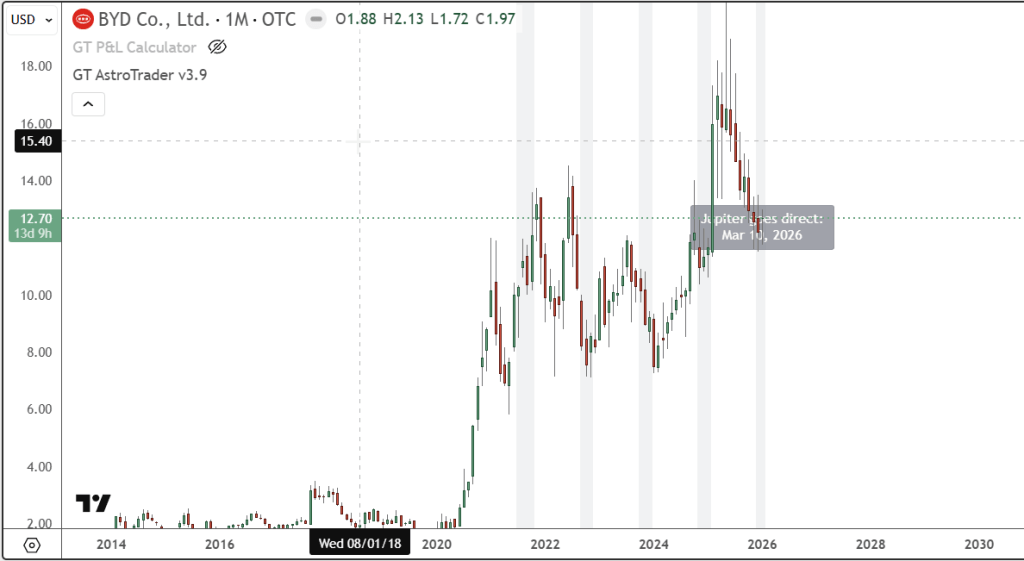
Jupiter going retrograde:
Jupiter Retro
A very simple example. Note the image above in which the grayed out sections represent the time when Jupiter went retrograde. Take a look at what happens (typically) when Jupiter goes from being retrograde to direct (which is when the gray area ends). Do you notice anything? If you had done nothing else other than buy this particular stock heavily at a time when Jupiter was about to go direct, might you have become wealthy or not?
Note that Jupiter will go direct again, on March 10, 2026.
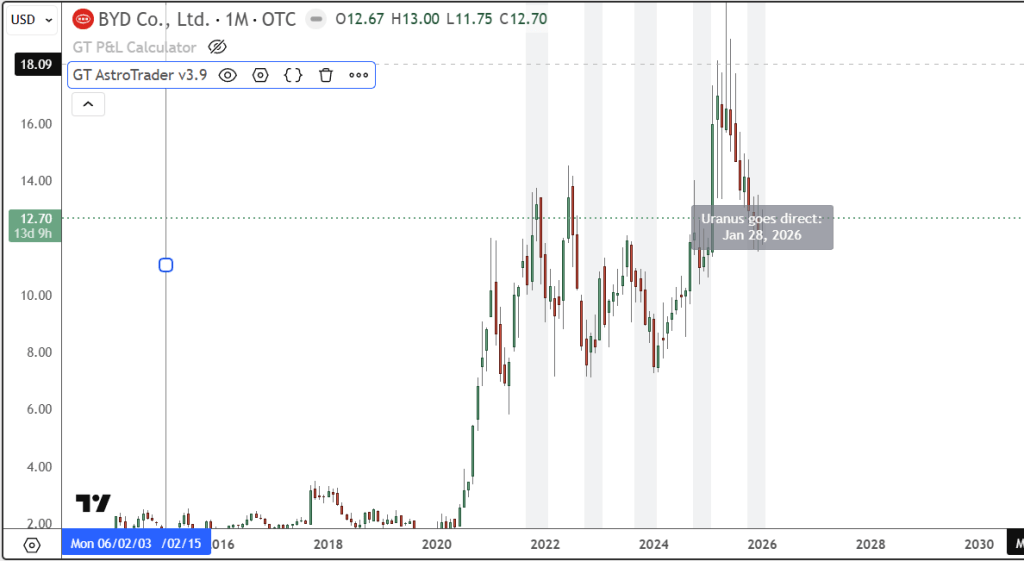
Uranus going retrograde:
Uranus retro
Here is a picture of Uranus going retrograde. Take a look at what often happens immediately at the beginning of when Uranus goes retro and what often happens when it goes direct. Would knowing this in advance help you to make better trading decisions?
Note that Uranus will go direct again on January 28th, 2026.
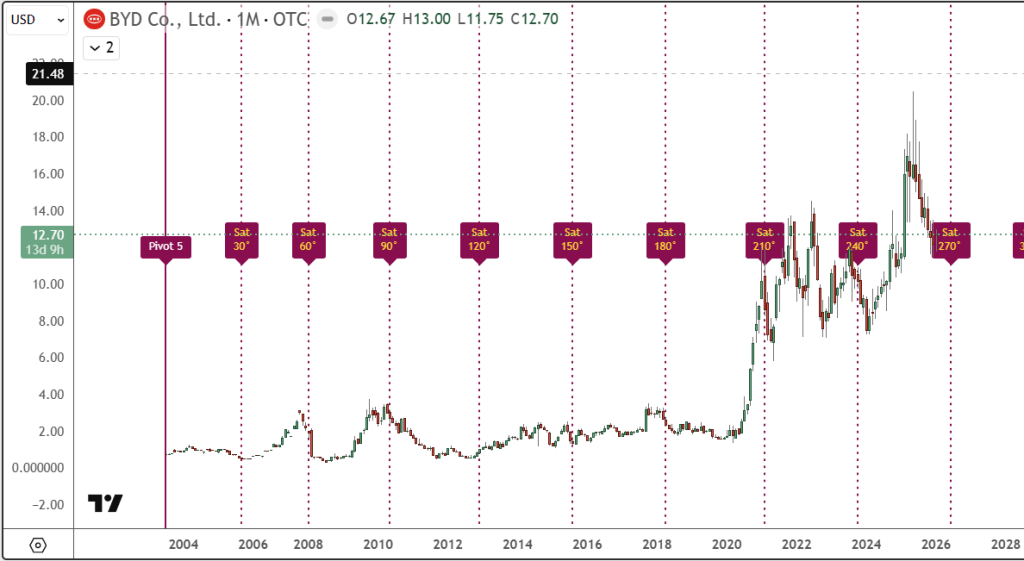
Every 30° of Saturn movement.
Saturn 30°
Could it really be true that there is as simple a market rhythm as seen in the monthly chart above, simply noting every 30° of Saturn movement beginning from the first trade date for this particular stock?
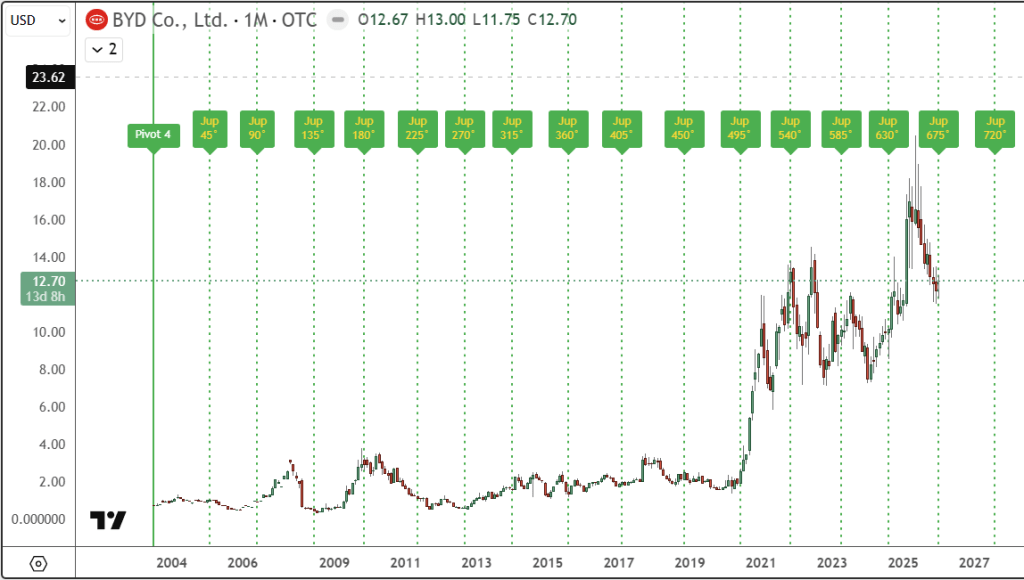
Every 45° of Jupiter movement.
Jupiter, 45°
Here we see Jupiter every 45° beginning from the first trade date of this stock. What does that tell you about whether or not it might be a good time to buy this stock right now?
Every 15° of Uranus movement.
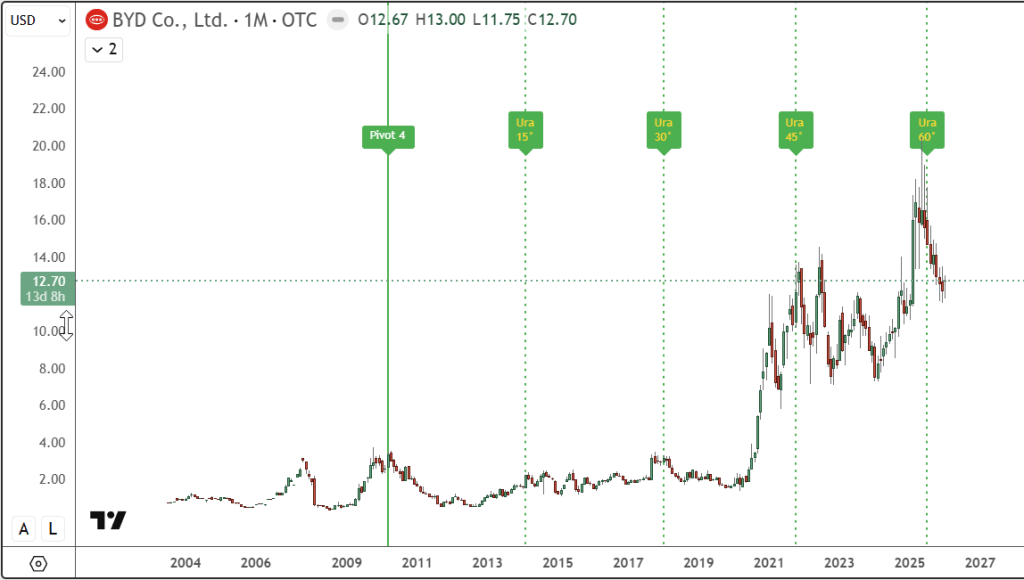
Uranus 15°
Every 360° of Mars movement.
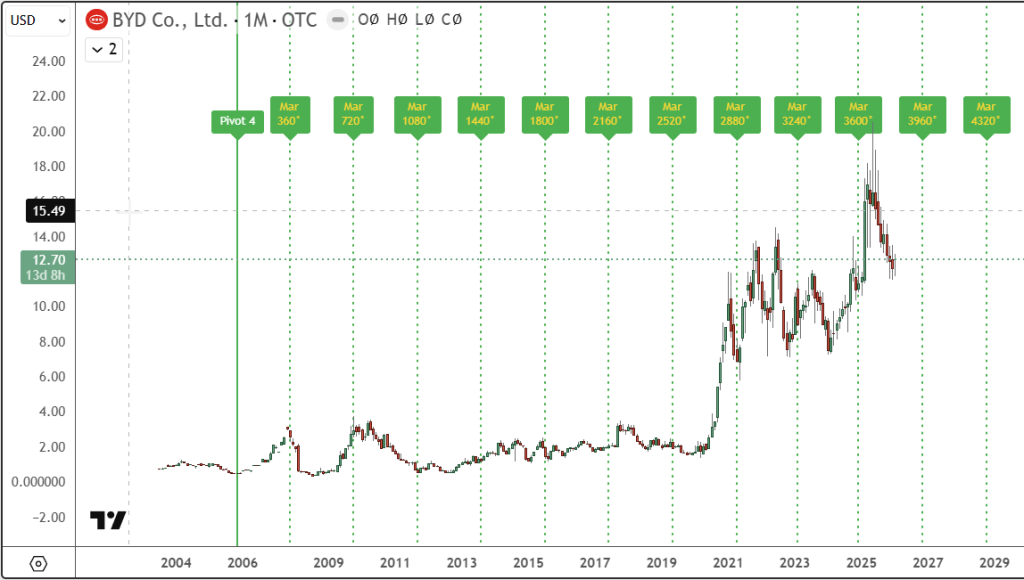
Mars, 360°
While Mars 360°does not perform quite as well (on a monthly chart) as do the other outer planets, note how brilliantly it forecasted the first two highs following the first low, in December 2005, followed by forecasting almost exactly, the date of the following low.
Seeing this, do you think it might be a good idea to note on a monthly chart when the next 360° of Mars will have passed since the last significant pivot on the chart?
 GT AstroTrader