
If each planetary orbit was completely round, then every cycle would take exactly the same amount of time. Mercury would do 360 degrees every 88 or 89 days, etc. But in fact, it doesn’t work that way. Sometimes it’s 87 days, sometimes it’s 91 days. Hence analysts that work with cycles get frustrated.
They will be following a cycle that seems to recur time and again. Just when they think they are comfortable committing their hard-earned funds to the trade, the cycle stops working. Why does the cycle stop working? Because the cycle that they were following, whether they knew it or not, was an astro cycle, and astro cycles change periodically.
For example: Did you know that because of the elliptical nature of the Sun and the Earth, that the Earth moves faster in January than it does in July? That’s why February only has 28 days. Because the Earth is moving faster, it needs less days to move X number of degrees. On the other hand, July 4th is the day that the Earth is moving the slowest it does all year long. That’s why summer days often have 31 days because in the summer it takes more days, to move the same amount of degrees.
Benjamin Franklin was a very capable astronomer. My guess is that he chose July 4th to be the founding of the United States government because he knew that July 4th was the day that the Earth is moving the slowest.
Be all that as it may, the point is you can’t just use 88 or 89 days as a cycle knowing that Mercury’s typical orbit runs 88 or 89 days. You can try it, and it will work from time to time, but then just when you need it to work the most, it won’t work. Because you’re not taking into account the fact that in some parts of their cycles, each planet is moving faster than at other times. On the outer planets, the difference can be measured in months.
To do astro-trading correctly and well, you need to have access to a tool which will give you good astronomical data. Fortunately, the internet is available and the internet can give you pretty much any information like this that you need, on demand. So, there is no excuse for not getting the right information.
Okay, having gone through that, let’s look at some more examples of how astro trading could have helped you had you known what to look for in the past.
Which is the cycle begin/end bar? 1, 2 or 3?
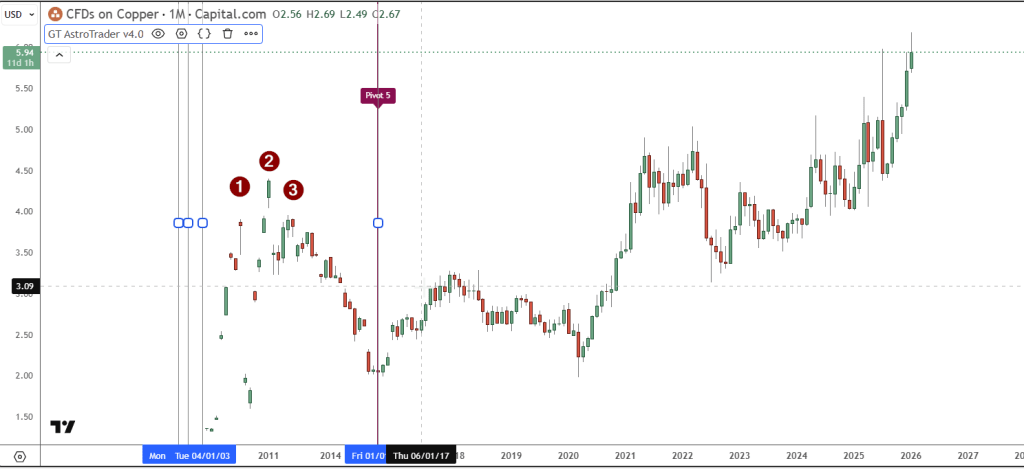
It is important that we pick the right starting point. For instance, looking at those 3 marked peaks above, which would you think is the best bet to be the cycle end of the previous rally, or the cycle beginning of the following decline?
A lot of people would choose #2 because it seems intuitive that the highest high would be the cycle top, but in fact it turns out that peak #3 was the one we wanted to use, as illustrated below.
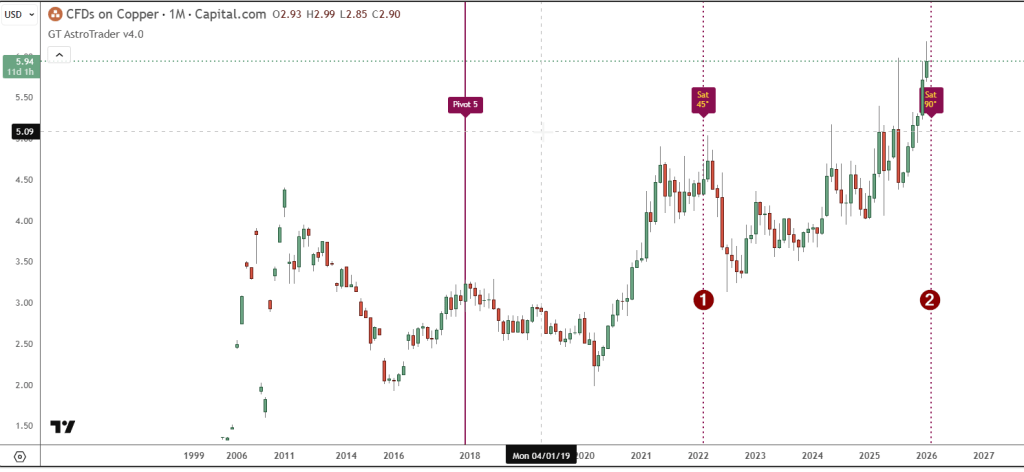
45° Saturn
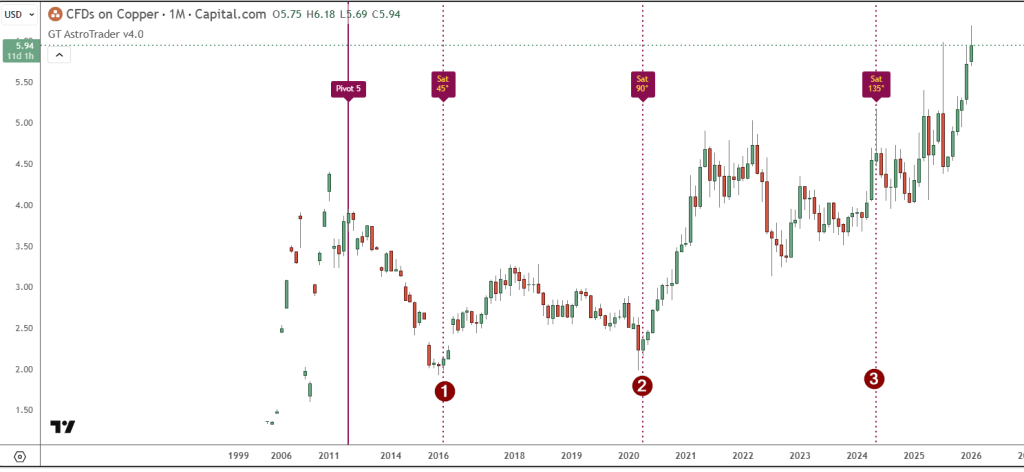
By starting our cycle analysis from the third peak as shown above, the next three 15-degree turns of Saturn all prove to be excellent entry points.
15° Uranus
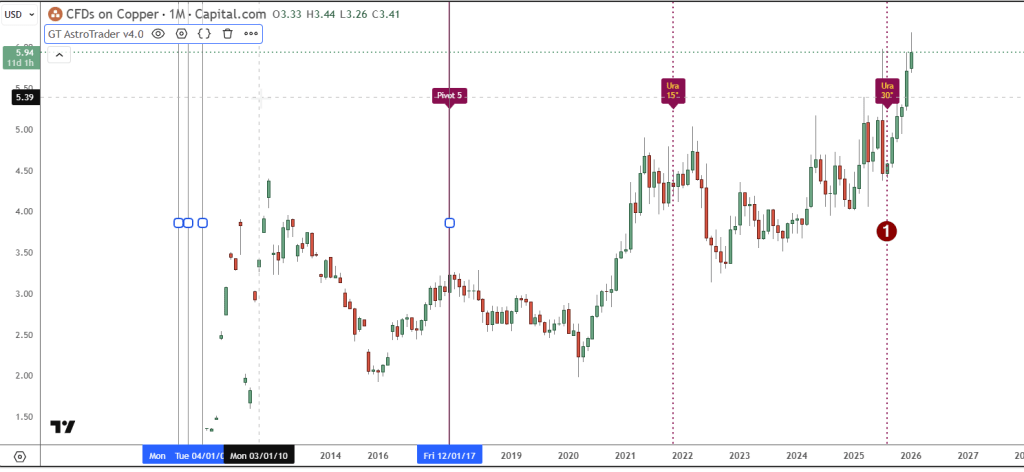
If we then move our starting point to the next relative high as shown above, then we find that 30 degrees of Uranus later, was another excellent entry point.
30° Uranus
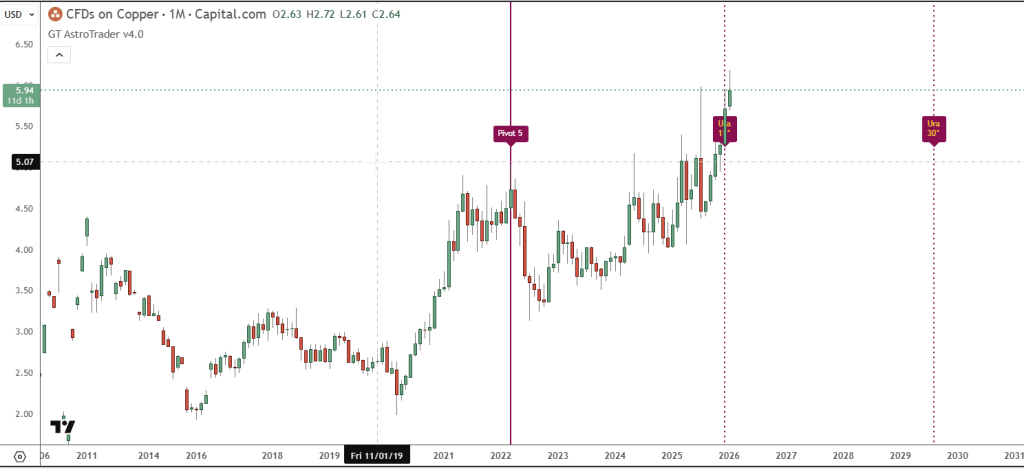
Continuing, if we move our starting point to the high shown above, we see that 15 degrees of Uranus later, we arrive at one month ago. If you are still long copper when you see this, do you think it might be a good idea to take some money off the table? Not sure yet? Let’s also consider the following setup, which shows a hit in one month, using 45 degrees of Saturn.
We now see an ‘Energy Point’ both immediately before and immediately after the current monthly bar. Are you starting to see the risk?
45° Saturn
A more classic technique
Jupiter and Saturn aspects.
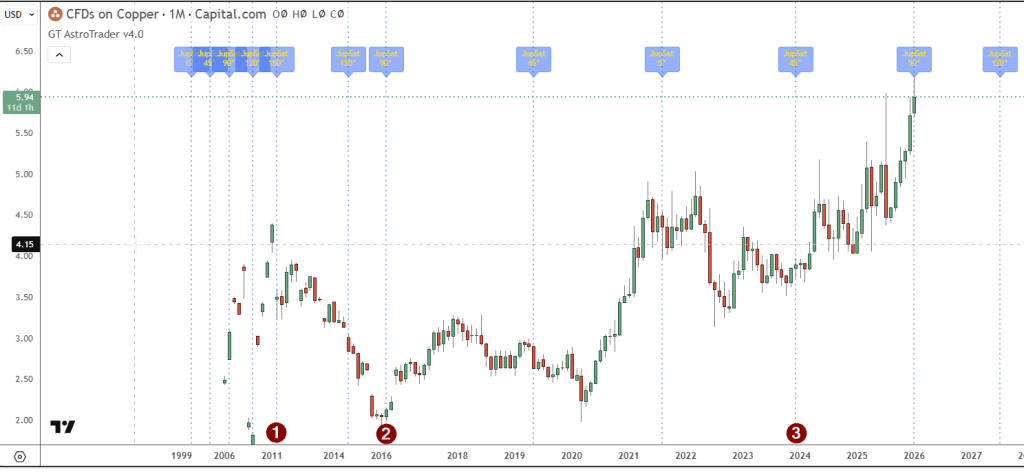
Let’s take our attention off of Uranus for a moment and let’s consider more of a classic look at “astro trading”. This is actually a more common technique amongst astro traders. Here we are looking at aspects of planetary pairs and the dates when they fall on notable angles as shown above. In this example, we are seeing aspects of Jupiter and Saturn.
As you can see, one, two, and three were excellent places to enter. Actually, that hit falling directly in the middle between numbers two and three, was actually a good place to short, wasn’t it?
Note again the warning. This month, we see a 90-degree angle between Jupiter and Saturn. They are square. Knowing this, if you understand the implications, you would take money off the table if you’re long.
Sun and Saturn aspects.
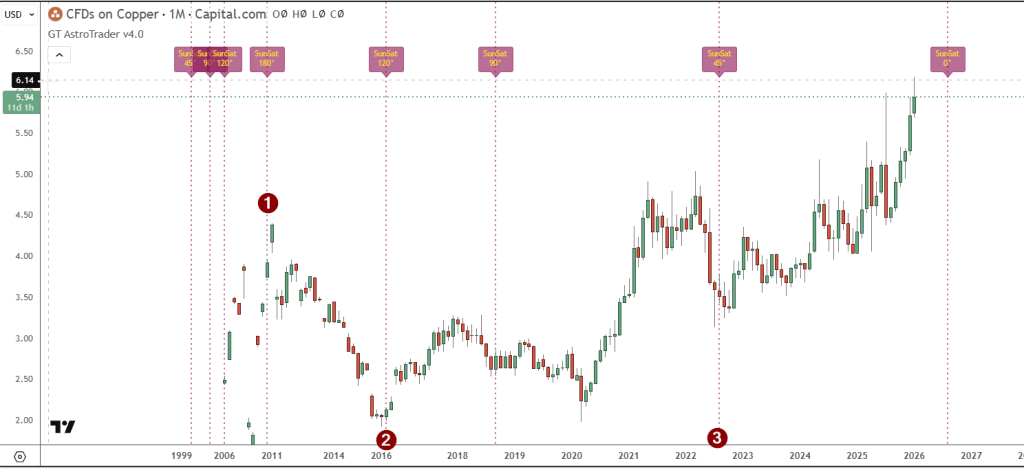
In the example above, we are seeing the dates of notable aspects between the Sun and Saturn. Hit #1, #2, and #3 were each off by a single bar – almost perfect places to enter a trade.
Conclusion
As you can see, the more we dive into this, the more clear it becomes that learning to Astro Trade might be the best financial decision you will ever make.
It goes without saying it will take some time, it will take some effort. The knowledge and the ability to use it will likely take a significant amount of effort and commitment on your behalf.
But, as you are beginning to see, this is the secret that made the legends of the trading arena over the last hundred years multi-millionaires. And this was back in the day when a $ million was still a lot of money!
That’s enough for now. Until next time, happy trading!
 GT AstroTrader
Leave a comment